The new Cold War with Russia and China (and censorship on social media)

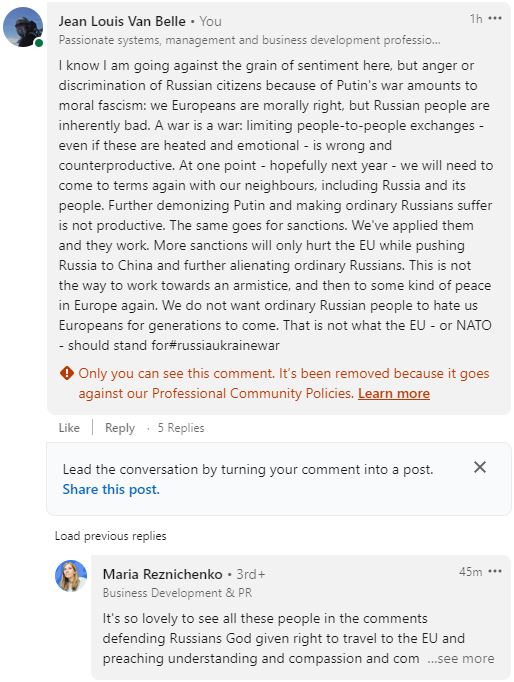
One man’s terrorist is another man’s freedom fighter. Russia and China engage in propaganda. The West, of course, does not. We only write about truth and peace and democracy. What nonsense! I reacted strongly – on my LinkedIn account – against what I perceive to be a new Cold War with Russia and China and – more to the point – how wrong it is to demonize not only leaders or systems but also people. Indeed, the Russian or Chinese people are not inherently bad and sanctions should, therefore, not be applied to people-to-people contacts, such as a ban on Russian tourism in Europe – which is currently being advocated by some European politicians (I am thinking of two new hawks here – both young, pretty and very woke, on the surface, at least).

My post was removed. See the screenshot below. It will not make me change my mind. On the contrary: I am someone who would rather defend or even exaggerate an unpopular view rather than adapt it to please the other side. It makes me feel that we live in dangerous times, and that free speech is under attack. Not only in the East but also in the West. This confirms what I wrote in previous posts. We are straight back where we were 50 years ago – right back to the old world order: a terribly Cold War. It is a Cold War with China, and a hot war with Russia too! I tell my children not to worry about it and just have fun but, deep inside, I feel very sad. It feels like this generation has failed on all fronts: climate change, peace, poverty, exclusion, etcetera. I hope the next generation will do better but, judging from what young and popular European politicians such as Kaja Kallas and Sanna Marin are pleading for, I have little hope.

They are supported very vocally by a majority of smart young business-minded people from former Eastern Europe as well as by very vocal Ukrainian migrants here. While I understand what they are saying, I would suggest they go back to their own country and make a difference there. We do not need more warmongering here in Europe.

As for social media censorship, some kind of regulation is obviously needed. We do not want senseless material to go viral. However, I feel the only way to keep it transparent is to do it like Twitter is doing it: they do not resort to trolling or patrolling threads and then randomly deleting tweets but just stick to clearly identify and labeling the source for what it is. For example: tweets by government officials (be they US, Chinese or Russian or whatever nationality) are clearly marked as such. Hence, exaggerated or weird claims are not being censored (removed) but their source is appropriately flagged. I like that. Facebook says it has policies in place that should filter things out but, whatever these policies are, they are not clear to me and I will, therefore, not use FB anymore for political comments.

I do not believe it is useful to try to actively filter out messages. Tracing and marking the source of a message should do. As far as I can see from my analysis while participating in Twitter discussion threads, Twitter is quite good at that. The interesting thing here is that both Russia and China have an official ban on Twitter but that the ban does not apply to government officials and that, in China and Russia itself, private users do circumvent the ban without too much trouble.

Elon Musk wrote that he was/is interested in acquiring Twitter because he wants to turn it into some kind of ‘absolutist free speech’ medium. Many people may think he cannot possibly be serious. Based on my (admittedly limited) experience with Twitter, I feel he has got a point. I like Twitter. As mentioned above, I feel that the regulation they have put in place is effective: clearly marking the nature of the source of a social media message is probably sufficient to make sure its readers read it with the “pinch of salt” that is required. I think the regulation of social media should be based on the Twitter model: one can write what he or she wants but you should identify yourself and what you stand for. The rest is for the reader to judge. We should not underestimate his or her intelligence and we should – surely – not judge in his or her stead.

You may not agree with my views above. That is fine. All that I am asking is that you question whatever would irk you and make you feel that I am totally wrong. If you come out of that exercise with a confirmation of your own views – even if they would be and remain diametrically opposed to mine – then that is fine. That is what rational discussion and finding a good middle ground through dialectical exchange is all about.

Post scriptum: You may think I should request a second look at the case from the LinkedIn editors. I did. I used their appeal procedure, and wrote this as justification for asking a review for the removal of my comments:

“I know my comment is a minority view but I wrote it because I feel it is true and because I feel I must go against the grain of sentiment here. I am one of few Europeans who have seen the horrors of war up close and who – unlike some of the people who may find it offensive – did not flee Ukraine but went to fight there. I came back. Alive and sane. Yesterday I was told some of my friends are dead or lost limbs. I think you should look at the Twitter model for weeding out comments. They label content as offensive or clearly mark the nature of the source. I wrote about that on my political blog just now: https://webeu.news/. I am fine with clear feedback: perhaps LinkedIn is not the fora for such discussions. However, I do not see why there should be no equal treatment of majority and minority views.”

I am curious to see if they will reply and, if so, what they will do or write. As for now, I will refrain from further posts or comments on political issues on that channel. It is not good for my business anyway, so I should not bother and do what is right for me. 🙂

The end of ideology and the (ir)relevance of NATO

Shortly after the Berlin Wall came down, the US-led alliance of nations that is known as the North Atlantic Treaty Organization (NATO) pushed the eastern borders of its territory all the way up to what are now the western borders of Russia, Belarus and Ukraine. [Instead of NATO, I could have referred to ‘the West’ as a whole, but it is better to be precise when writing about these things.] It is a rather moot point whether or not such expansion was tacitly agreed with the leaders of what was then a rapidly disintegrating Soviet Union. In 2014, former Soviet leader Mikhail Gorbachev said that NATO’s enlargement was, quite simply, “not discussed at all” at the time, so we should probably leave the historical discussion at that.

One thing is quite clear, however: no one in Europe thought Ukraine was part of Europe until Mr. Putin decided to invade it. That is the number one reason why NATO refused to get involved in it: the ‘in’ or ‘out’ of area distinction is just a legal nicety which NATO (the US, I should say) uses as it pleases. Indeed, NATO went to Afghanistan so there is no reason why they should not go to some other area if NATO member countries would agree on going there. Personally, I think it is a very wise decision for NATO members to leave NATO out of the war between Ukraine and Russia. Furthermore, from the historical record, it may not be very clear that NATO would be pushing east, but one thing that is very clear is that NATO would not turn against Russia. So what is it that I want to say here?

I just want to illustrate such things are a matter of choice and, at the same time, question the relevance of NATO: if NATO is not there to defend us against potential Russian aggression, then what is its use? The only reasonable answer is: NATO is there to do whatever the US wants its European partners to do with it, and they can decide to go along with it or not to go along with it. If Europe is serious about European defense integration, then we should cut the umbilical cord with the US.

Think of it. Shortly after the Berlin Wall came down, political philosophers (read: ideologues) like Fukuyama mourned or, more likely, celebrated the ‘end of ideology’. Fukuyama, for example, wrote this: humanity has reached “not just … the passing of a particular period of post-war history, but the end of history as such: That is, the end-point of mankind’s ideological evolution and the universalization of Western liberal democracy as the final form of human government.” Thirty years later, history proved him wrong: unlike the Soviet Union, China did not disintegrate. It successfully suppressed the Tiananmen protests and it restructured its economic and political system, in a very unique model which you may or, more probably, may not want to qualify as liberal. I think of this as follows:

1. From an economic point of view, it is probably more liberal than any other system (just care about money, business and wealth production).

2. From a political point of view, the system is not what many casual observers think it is: China’s one-party system clearly allows for different opinions being expressed internally and fierce competition from within the system. Otherwise China would not be where it is now. Also, I have had the pleasure to interact with Chinese diplomats in Asia (12 years of diplomacy, which ended in Afghanistan) and I found they suffered less from the typical ‘groupthink’ problem that marks some other diplomatic corpses.

In any case, what is obvious is that its system is, by far, more successful than the Anglo-Saxon (US or UK) or European system, as evidenced by the fact that China, over the past decades, grew to become the largest economy in the world. Indeed, China’s GDP is now commensurate with its population: measured in purchasing power parity terms, it is the largest in the world. Back in 1989, China’s GDP was only ninth in the rankings. So are we or are we not witnessing the end of ideology or – worse – the end of history, or not?

The answer is rather obvious to me: history never ends (it was so foolish to write something like that) and, therefore, our views on how to manage our societies will also continue to conflict. In that sense, we are surely not witnessing any end to ideology. If anything, that is what the recent clash around the US and China is all about. Truly wise political philosophers should just observe current international realities: the world has, de facto, become multipolar. It is one interconnected world indeed, but it is comprised of many cultures and very different political and economic systems. Such diversity is good.

So, yes, while we are not seeing the end of ideology, we should move beyond ideology and focus on peaceful coexistence and finally be very serious about working towards “the greatest good for the greatest number”, as Jeremy Bentham – the father of liberalism, utilitarianism and pragmatism – said we should aim at above anything else. That means, among other things, working with rather than against China. And it surely means refraining from any aggression or interference in the internal matters of other countries – especially those countries that, through sheer hard work, have seen their wealth growth to levels that are at par of the wealth of the West.

Also, when war is inevitable – as it was between Ukraine and Russia this year – then one should respond firmly (as Europe and the US did) but one should also prepare for armistice and peace as soon as possible. That is not happening now: shipping US$40b arms packages to Ukraine is not what is needed now. For those who are not familiar with such numbers: the annual defense budget of Russia is about US$65b and most of that is spent on salaries: not on highly lethal offensive equipment. So, yes, such interventions totally reversed the initial perception of a David versus Goliath relation between Russia and Ukraine: Ukraine is now, by far, the most powerful army in Europe, and it is not because of NATO or European support. It is because the US took over. That is a fact. Do we want that? Possibly. We just need to be aware of it.

The frontlines are all but frozen now, and the US and Europe need to work with China to end the war. Through hard-nosed diplomacy rather than more sabre-rattling. More sanctions do not only hurt ourselves but – more importantly – risk alienating Russia (not only its leaders but – much more importantly – their citizens) to a point of no return. That is not what we want: Russia is and remains our neighbor, and – just like individuals – countries need to learn how to live with their neighbors. :-/

Post scriptum: When you are a European or an American reading this, you may be irked and think that I think of the Chinese way of living as, somehow, being superior to ours. I do not. I lived in Asia for a long time (20+ years), and I also lived in the US (Washington DC) for a couple of years (I was married to an American woman). Now I live in Brussels. In the country where I was born and grew up: Flanders, Belgium, Europe (Europeans have multi-layered identities, don’t they?). I think of it as the best place in the world, but that is probably because, yes, I was born and grew up here. There is no place like home and, yes, ‘home’ is, of course, a very different place for all of us – just like family is different for all of us. That is good. That is how it should be. That is why the world is such fun place and why wars should be avoided at all costs: war destroys homes and families. I have witnessed that in Afghanistan and in Ukraine. I have seen enough of it.

Just for the record, I add a personal note on why I think I should speak up in regard to the need to seek peace with Russia. I left for Ukraine as soon as President Zelensky made his appeal to European and other international volunteers to join the fight. I would have stayed on (many left after the terrifying strike on the Yavoriv base, but I did not) but, sadly, when seeing lots of idiot volunteers and private companies and militias from the US swamping in about a month after we had arrived, I thought it was no longer worth it: we are all ready to die for the right cause but if, I use Sun Tzu’s words here, you no longer find yourself on the right side of the Moral Law, then it is better to go home. From a practical point of view, the Ukraine-Russia war is now a war between Russia on one side, and Ukraine and the US on the other. It is no longer the war between Russia and Europe that our media pretend it to be. Here too, I do not mince my words: Yankee, go home. Please. We Europeans can and will deal with Russia. They are our neighbor. We will find a way. How?

Well, for starters, the EU’s relationship with the country that now has the most leverage on Russia (yes, China) has remained relatively unaffected. Let us bank on that to begin with. I also think Europe’s diplomats do not have the kind of ‘with or against us’ attitude that is so harmful in such situations. Let me be blunt here: European diplomats do not display arrogance and are not complacent. That is why Chinese and Russian diplomats will probably find it easier to talk to them. If your only tool is a hammer, then every problem looks like a nail. So, if your only tool is a gun, then… Well… Then everyone looks like your enemy, right? Europeans do not think like that. Why? History: this continent remembers its wars and has learnt from them. Unlike the US, Europe did not go to war again after WW II (except for the Korean war, perhaps, as part of the United Nations). The US has fought many wars in foreign lands since then, and participated in even more proxy wars during the Cold War. These wars have been everything but successful, and I see little or no learning from them at all. :-/

The implosion of the EU

The Russian Foreign Minister pronounced the EU officially dead – as far as Russia is concerned, at least: ““There are no relations with the European Union as an organization. […] Moscow only has relations with individual EU nations now.” Similarly, China finds the EU also increasingly difficult to deal with, and may also decide to just treat the EU for what it has become: a wasteful international bureaucracy. Brexit, the mismanagement of the COVID-crisis, and the increasingly diverging politics and political views within the EU only exposed the deep-rooted rot.

The Russian and Chinese Foreign Minister both want to strengthen the UN Security Council, which is probably a good thing – because the UNSC embodies the kind of nasty but effective realist deal-making our brave new multi-polar world desperately needs – especially now that all trust in the US as a ‘global policeman’ has been eroded. Biden calling Putin a ‘killer’ has not helped matters in this regard.

The UNSC might work – especially with Germany playing a more active role now as non-permanent member, probably seeking to reform it so as to achieve permanent member status. Enlargement of the UNSC should not be based on the preferences of the current permanent members, but on real power-projecting capabilities and other assets that may help to stabilize an increasingly volatile world. We may criticize Russia and China but – unlike democracies such as India – these are societies – or social systems – which have managed to define and, more importantly, implement medium- and long-term political and economic objectives. The numbers of 20 years of Putin, and a rapid comparison of China’s growth versus that of India (similarly endowed with natural and human resources) speak for themselves. Measured against Bentham’s utilitarian moral rule (what produces the greatest good for the greatest number?), Russia and China have surely done better than any other (large) society over the past 20 years.

As for Europe, I am not sure it has much future. Even as a name, it does not work very well: Europa was just a consort of Zeus, and she came from a region which is currently referred to as Turkey. So what message were ‘European’ politicians trying to convey with the idea of Europe anyway? :-/

Ursula von der Leyen still has another four years to go, and does much better than inebriated Juncker (but then he was, without any doubt, the weakest EUC President ever), but she faces an uphill (impossible?) housecleaning task. Perhaps she should speak more German than French? With Brexit, a return to either is good. Let’s see what Germany’s voters say in September. Their vote is more important than others’. That is not a racial prejudice, but just fact: some people matter more than others, and some countries matter more than others, too!

[…] So what makes sense, then – in terms of international order? Perhaps the idea of weighted voting in the larger UN system should be re-considered. It may well be the only rational alternative to a return to the 19th-century international system, which was based on rivalry between nation-states. The only difference is that the world population will soon reach the staggering 8 billion mark, up from less than 2 billion in 1900: it more than doubled since I was born (which is 50 years ago). Doomsday thinking is not warranted, however. 🙂 And the nation-states are different. Two of them (China and India) now account for 36% of the world’s population. Asia as a whole will account for about 55% of the total in 2050, Africa 25% share. Europe and North America? Probably about 10% only, but this projection is based on healthy (overoptimistic?) demographics for the US and Canada.

The US alone still accounts for about 40% of the world’s spending on arms and the military. To protect whom against whom? Europe from Russia? The Middle East, Central Asia or Africa from fundamentalists? Democracies against dictatorships? And with what mandate, really? The US bypassing the UN Security Council in 2003 (the invasion of Iraq), as well as on numerous other occasions and related matters (including the first Gulf War) damaged its international credibility beyond repair. I worked for about 10 years in Afghanistan – about half of that time I was paid out of US taxpayers’ money – and I understand the appeal of the Yankee, go home idea very much. I believe that, since Trump, more Americans start to understand it too.

What about NATO? It served two purposes: one was to prevent war between its members, the other was to protect Europe against the Russians. The latter threat is no longer relevant in this interdependent world, so NATO should (also) scale down its xenophobic rhetoric, and focus on the first: reduce tensions between Greece and Turkey, focus on stability in the Balkans, reduce tension in former Eastern Europe (please stop expanding, NATO!), etcetera). Unfortunately, rational decision-making and international institutions are difficult to marry. :-/