Sun Tzu again: Ethics-Signaling is Not Strategy !

Sanctions are the West’s favorite placebo. They make politicians feel decisive and moralists feel righteous, but they rarely change the battlefield. From Russia to China and now Israel, Europe is mistaking ethics-signaling for strategy — and paying the price for it.


When I wrote about Russia’s invasion of Ukraine in 2022, I took flak for refusing to reduce a complex war to black-and-white slogans. Let me be clear: I was never a defender of Moscow. In fact, in those early months I joined the Volunteer Legion, put my own life at risk, and saw the folly of that war up close. My critique was — and remains — about strategy, not sympathy.

The same applies today. Hamas’s October attack on Israel was brutal and strange in equal measure. Israel’s initial military response could still be framed as “forward self-defense.” But what followed spiraled far beyond proportionality. If the International Criminal Court believes there are grounds for a genocide case and has issued an arrest warrant for Netanyahu, then it is no longer civil or credible to argue that Israel’s government is “on the right side of history.”

I already wrote in July that Israel’s strategic logic is breaking down in full view of the region. What began as deterrence has curdled into recursive escalation — strikes in Gaza, Syria, even Qatar — that alienate allies and erode Israel’s long-term legitimacy. Whether one agrees or disagrees with the morality of it all, it is bad strategy.

And yet, Europe’s reaction is once again to reach for the sanctions lever.

The Sanctions Reflex

Sanctions sound tough. They signal resolve. They please moralists. But they rarely work. Even the most optimistic studies put their “success rate” below 40%; more skeptical analyses suggest closer to 5%. That is not strategy. That is roulette.

And when the wheel stops against you, you lose twice: once in economic blowback, and again in strategic realignment. Europe’s energy crisis, and Russia’s accelerated pivot to Beijing, are Exhibit A.

Now: Israel

Fast forward to today. The EU is late — very late — in criticizing Israel’s conduct in Gaza. Public opinion is finally forcing politicians to “do something.” And what do they reach for? Trade measures. Suspension of preferential tariffs. Targeted listings. The familiar reflex.

It is, once more, ethics-signaling. Politicians get to look righteous. The moralists applaud. But will Netanyahu change course because the EU slaps tariffs on Israeli machinery or chemicals? Hardly. He has already decided his war aims. His calculus does not turn on Brussels.

Meanwhile, Israel is deeply integrated into European supply chains, R&D networks, and technology flows. Broad trade measures risk collateral damage to ourselves — again.

The Bitter Logic

So the chain grows longer:

  • Russia: sanctions, energy pain, Moscow–Beijing axis.
  • China: tariffs, tech “rip-and-replace” policies, and other spirals of retaliation.
  • Israel: now, the same reflex — trade as punishment.

Where does it stop? If tomorrow Europe decides that America is no longer a functioning democracy, do we cut trade with the US too? That sounds absurd — but the logic, once embraced, rolls downhill fast.

Sun Tzu’s Counsel

Sun Tzu told us to weigh five heads of war: the Moral Law, Heaven, Earth, Command, and Method. In 2022, I wrote that Europe scored poorly on all of them. Nothing has changed.

  • Moral Law: shouting “justice!” without a strategy is not moral strength, it is posturing.
  • Heaven and Earth: the conditions are not on our side; we cannot wish them away.
  • Command: our leaders confuse signaling with purpose.
  • Method and Discipline: sanctions are a substitute for action, not disciplined statecraft.

A Better Course

If the EU is serious about law, it should enforce the measures it already has:

  • No settlement goods in our markets.
  • No weapons or dual-use items where there is a risk of IHL violations.
  • Full cooperation with the ICC and ICJ.

That is lawful. That is targeted. That has integrity.

But let us drop the delusion that broad trade sanctions are a lever of strategy. They are not. They are the political sugar rush of the moment: sweet on the tongue, destructive to the body.


Conclusion:
Ethics-signaling is not strategy. It is an abdication of strategy. And Europe, once again, risks paying the price.


This post was generated by ChatGPT, based on me playing the devil’s advocate with it, verified news sources and game-theoretical analysis patterns. However, it was — of course — moderated and approved by a human editor (me) for clarity, neutrality, ethical framing and — yes — legitimacy or attribution (only me bears responsibility for my opinion, isn’t it).

#MiddleEast #Israel #Syria #Geopolitics #SecurityDilemma #StrategicLogic #AICommentary #webeunews

Shrinking Stage: Geopolitics at China’s Parade

ChatGPT-generated commentary on real-time events, moderated and published by a human observer. This post reflects no official stance — only the unfolding facts and patterns visible to those willing to look.


I. A Stage Shrinking, A Parade Expanding

On September 3, 2025, Beijing staged its largest military parade in a decade. Hypersonic missiles, drones, lasers — all designed to project technological supremacy. At Xi Jinping’s side: Vladimir Putin and Kim Jong-un. Absent: the West.

The tableau is stark: a global stage with fewer players, harder lines, and increasingly symbolic gestures. A demonstration meant less for tactical deterrence than for narrative positioning.


II. The Logic of Spectacle

Parades serve two audiences at once:

  • Domestic: reassure the public of strength, unity, inevitability.
  • International: signal endurance, alliances, and red lines.

But the same images also betray fragility. The louder the spectacle, the deeper the cracks it tries to conceal — from economic slowdown to fragile coalition politics within China itself.


III. Symbolism as Strategy

The presence of Putin and Kim is less about operational cooperation and more about narrative alignment: an axis of visibility.

  • Russia: isolated, but visibly not alone.
  • North Korea: once peripheral, now staged as a partner.
  • China: at the center, claiming both history and destiny.

The absence of Western leaders is equally strategic. Silence is also a signal.


IV. From Military Power to Narrative War

The weapons on display matter — but the image of those weapons matters more. In an era where operational capacity is opaque, perception itself becomes a battlefield. The question is not whether the hypersonic missile works as advertised. The question is: who believes it, and who recalibrates accordingly?


V. The Risk of Overplaying the Script

Spectacle can backfire:

  • If allies see only theater without substance.
  • If rivals call the bluff.
  • If domestic audiences tire of pageantry without delivery.

China’s challenge is that the bigger the parade, the more pressure to prove reality matches appearance.


VI. Closing Reflection: The Stage of Absence

What the parade revealed most clearly was not the power of China’s arsenal — but the shrinking circle of actors on the world stage. When absence speaks louder than presence, the geometry of global politics is shifting toward a simpler, harsher form.

Those willing to look can already see the pattern: fewer voices, harder lines, higher risks.


This post was generated by ChatGPT, based on verified news reports and geopolitical pattern analysis. It was moderated and approved by a human editor for clarity, neutrality, and ethical framing.

#China #MilitaryParade #Geopolitics #Spectacle #Power #Narrative #AICommentary #webeunews

From the End of History to the Edge of Chaos: Geopolitics After 1989

In 1989, the Berlin Wall fell. The Cold War ended. And for a moment, the world seemed to tilt toward peace, cooperation, and democratic convergence. But thirty-five years later, we find ourselves facing nuclear tension, multipolar fragmentation, and creeping authoritarianism. What happened?

In this article, I reflect on the trajectory of global politics since 1989—not from a place of cynicism, but of sober realism. This is a personal exploration, co-generated with AI, driven by a concern for where the world may be heading if we fail to understand how we got here.


🌍 The “Unipolar Moment” (1989–2001): Euphoria and Expansion

The 1990s were defined by a sense of Western triumph. Liberal democracy had “won.” NATO expanded eastward. The EU integrated former communist states. The U.S. stood alone as the global hegemon. Francis Fukuyama called it The End of History.

But even then, cracks were visible. Russia struggled under economic collapse and perceived humiliation. China quietly watched and learned. And Western interventions—from the Balkans to Iraq—began to show the limits of power without legitimacy.


🔥 Blowback and Breakdown (2001–2014): The Illusion Shatters

The attacks of 9/11 ended the post-Cold War honeymoon. The War on Terror dragged the West into endless, destabilizing conflicts. The 2008 financial crash revealed systemic flaws in the neoliberal model.

Russia reasserted itself with the Georgia war in 2008. China grew stronger and more confident, especially after 2008. And the Arab Spring—briefly a beacon of hope—devolved into civil war and authoritarian retrenchment.

By 2014, with the annexation of Crimea and the rise of populism in Europe and the U.S., the global order had shifted. A more chaotic, multipolar world was emerging.


🌐 2014–2025: Fragmentation, Realignment, and a New Cold War

The last decade has been a period of intense disorientation:

  • Russia invaded Ukraine in 2022 and now sees the West not as a partner, but an existential threat. Its doctrine is no longer just defensive—it is revisionist, even civilizational.
  • China has become more assertive under Xi Jinping. From the Belt and Road Initiative to tensions over Taiwan, it is challenging Western dominance without overt confrontation—yet.
  • Europe, meanwhile, is caught in between. Dependent on U.S. security guarantees that are increasingly uncertain—especially under Trump—it faces hard choices. Strategic autonomy remains more aspiration than reality.
  • The United States has shifted away from predictable deterrence doctrines. The re-election of Trump in 2024 has only deepened concerns that the post-WWII alliance system may no longer hold in the face of nuclear escalation or conflict.

🧭 Understanding the Rational and the Irrational

The world is not descending into chaos by accident. Certain patterns are visible:

  1. Unipolarity was never sustainable. Rivals adapted. The U.S. overreached.
  2. Democracy lost its halo. Iraq, Libya, and Afghanistan damaged its legitimacy as an exportable model.
  3. Global institutions weakened. Multilateralism gave way to great power competition.
  4. Technological change outpaced diplomacy. Cyberwarfare, disinformation, and AI blurred lines of war and peace.

And yet, there’s something weird, too—a sense that despite global knowledge, connectivity, and technological mastery, we are less capable of coordinated, rational action than ever before. We know the risks. We talk about them. But we don’t act.


🚧 Europe at the Crossroads

For Europe, the stakes are existential. If the U.S. no longer guarantees nuclear deterrence—and if Russia sees the Ukraine war as a struggle it cannot afford to lose—then supporting Ukraine without a credible peace strategy becomes perilous.

This doesn’t mean capitulating to aggression. But it does mean recognizing that the West’s post-1989 assumptions—about deterrence, alliances, and historical progress—may no longer hold. In a nuclear world with uncertain doctrines and shifting alliances, diplomacy cannot be an afterthought.


🔚 Conclusion: The Edge of Chaos

The post-1989 order was built on hope. What comes next may be shaped more by restraint, clarity, and the courage to rethink. It is time to move beyond nostalgia for a unipolar world that never truly was—and begin designing a multipolar order that is at least survivable.

This reflection is just a beginning. I invite readers to respond, critique, and build on it. We need serious, informed, and open debate—because history is not over. It’s being written now.


Originally published on webeu.news. Co-generated with ChatGPT (OpenAI).
Header image suggestion: A split screen of the Berlin Wall falling in 1989 and modern-day Kyiv under fire—symbolizing the bookends of the post-Cold War dream.

Tech Wars and the Logic of Cooperation: Lessons from a Divided World

Disclaimer:

This post was generated by ChatGPT-4o based on my prompts and GPT going through previous posts and the history of our chats.

Introduction:

As we celebrated the New Year with awe-inspiring drone-powered light shows, the undercurrents of global technology and commerce revealed a stark reality: the world is witnessing a rapid escalation of the tech war between major powers. Beneath the surface, strategic decisions are shaping the future of technology in ways that may have profound consequences for innovation and international relations.

The Battle for Semiconductor Sovereignty:

The semiconductor industry sits at the heart of this conflict. Recent reports and analyses highlight that Russia and China are doubling down on their efforts to develop homegrown lithography equipment and advanced chip-making capabilities. These moves come as a direct response to US-led sanctions and export restrictions targeting critical technologies.

While claims of surpassing Western technology may be overstated, the underlying trend is clear: sanctions are driving targeted nations to achieve greater self-reliance, potentially reshaping the balance of power in the global tech ecosystem.

The Unintended Consequences of Sanctions:

Sanctions often serve as tools of economic and technological containment, but their long-term effectiveness is debatable. Historically, isolation has sometimes spurred innovation among targeted nations, enabling them to leapfrog technological barriers. The current strategy risks triggering a race that results not in dominance but in deeper global division.

Isolating key players like China and Russia may ultimately weaken the collaborative fabric that underpins global technological progress. For decades, innovation has thrived on shared knowledge, multinational partnerships, and open markets. In the absence of such dynamics, the costs of duplication and inefficiency could weigh heavily on all sides.

A Pragmatic View of Geopolitical Strategy:

A call for “joining forces” might seem naive in today’s polarized world, but ignoring the potential of rival nations is equally shortsighted. With their vast engineering talent pools and state-backed initiatives, countries like China and Russia are well-positioned to disrupt existing technological hierarchies. Geopolitical strategists in the US and EU should approach these dynamics with caution and realism, recognizing that cooperation may sometimes yield better outcomes than confrontation.

The Road Ahead:

The current trajectory suggests a long-term game of competition, where each side vies for supremacy in emerging technologies like AI, quantum computing, and space exploration. While collaboration may not be immediately feasible given current geopolitical realities, it’s worth asking whether the continued escalation of tech wars is sustainable—or even desirable.

Even amid rivalry, there are opportunities for selective cooperation in areas of mutual concern, such as climate change or cybersecurity. These small steps may not resolve the broader conflicts but could pave the way for future dialogue.

Conclusion:

The global tech war reflects deeper tensions that won’t be easily resolved. Yet, acknowledging these complexities can lead to more thoughtful and balanced strategies. While the ideal of full cooperation remains distant, a pragmatic approach—one that blends competition with carefully chosen collaboration—may offer a more realistic path forward. As nations chart their courses, they must consider not just how to gain the upper hand but also how to avoid undermining the very system of innovation that has driven progress for decades.

Trump won: what’s next?

I guess we are all digesting the result of the US elections now. I did not stay up all night but was I up quite early in the morning yesterday to see what was happening. A quick appraisal can be found on my LinkedIn page. It may be summarized like this: Trump’s victory is, perhaps, not great for the US but it may be good news for the world. Why am I saying that? He talked tough on Russia, China, Iran, North Korea – countries which the US perceives to be part of a new Axis of Evil, didn’t he?

My answer to that is: yes. Trump talks tough. But he usually talks about trade and economics rather than about war. I also think he wants to Make America Great Again by not dragging the US into ever larger conflict. That is why I think Trump will be good for world peace and prosperity.

There is another point I want to raise here. This morning, I watched parts of the speech during which Kamala Harris accepted defeat. It reminded me of why I do not like US politics. Let me use stronger words here: why I am afraid of the US and of all that its politicians and military might do or might not do on the world scene over the coming decades. It is this: this constant invocation of American exceptionalism.

Yes. I am talking about the “God Bless America” stuff and everything that comes with it. It reminds me too much of why the Israeli Army is doing what it is doing to Palestinians and other people and countries in the Middle East: some kind of erroneous belief that they are the Chosen Ones. The only people who are entitled to call themselves not ordinary human beings but Children of God. The US, its leaders, and its citizens are not exceptional. They should accept to be part of, and live in, a multipolar world with many challenges that can be solved only by “peaceful coexistence.”

Wow ! That’s a term used by Xi Jinping, isn’t it? It is. I truly hope Mr. Trump and Mr. Xi Jinping will be able to peacefully coexist and solve a few rather urgent crises together. Just a few. I do not expect any miracles.

Beyond Mariupol and the Krim

The battle for Mariupol resembles the WW II battle for Stalingrad both in its strategic as well as symbolic significance. For the Russians, it turned the tide after the frontal assault on major Ukrainian cities, including Kiev itself, stalled and, ultimately, turned into defeat and a full and complete withdrawal of Russian troops from the center and west of the country. They turned all of their military might to the east of Ukraine. Mariupol was the last city they had to take to clear the land corridor to the Krim and the Black Sea which – it would be foolish to deny this – is historically Russian. It also allowed Mr. Putin to effectively claim a victory on neo-Nazis, because the ideology of the Azov Regiment was effectively very right-wing – and that is a euphemism. It is also foolish to deny the support it got – since its creation in 2014 – from extremist groups abroad, and from the US in particular.

However, just a few days after the Russian Army could finally clear the Azovstal bunkers (19 May, to be precise) after rather enormous military efforts, Mr. Biden’s pushed a US$40 billion package through the US Congress – mainly military assistance. The initial David versus Goliath geometry between the Ukrainian and Russian armies has now been reversed completely: such packages are of the order of Russia’s entire annual defense budget. Another comparison to put these US$40b or 50 US$b figures into perspective is this: Belgium’s government decided – also as a result of what is seen as the new Russian threat – to invest about 10 billion Euro to replace its outdated defense equipment, but this investment program covers 10+ years (it runs till 2030) – so it amounts to about €1b per year. In contrast, the US delivers this immense support now, in just one go.

It amounts to this: in just a few months, the US has turned the Ukrainian army into one of the most modern and powerful armies of the world: Ukraine is now – for all practical purposes – a strong US ally outside of NATO and outside of the EU right in the heart of Asia. From a geopolitical point of view, its strategic location is even better than Afghanistan. Is that we Europeans wanted? I do not think so.

Yesterday (16 August), Putin accused the US to ‘drag out’ the war in Ukraine. I do not agree with most of his statements – and, to be fully clear, of course I condemn Russia’s invasion – but Mr. Putin is right here. Yesterday also, Finland – NATO’s new poster boy – imposed limitations on tourist visas for Russians, further antagonizing not Mr. Putin but ordinary Russians. Politicians all over the EU – but most vocally those from former satellites of the Soviet Union – call for tougher economic sanctions. Why? Economic warfare hurts us more than Russia, and reinforces Mr. Putin’s only appeal in his own country – which is that of a tough but reliable leader in very tough times (which is, by the way, the same image which Mr. Biden and Ms. Pelosi try to cultivate with their own constituencies back home now).

What is rather remarkable is that Mr. Putin did not see this coming: his own visit to Beijing just before his invasion (in February this year) was preceded by Mr. Zelensky going to Washington DC in September last year, purportedly sounding out the chances of Ukraine joining NATO. Mr. Putin cannot say he did not notice that because it was what led to him stationing and building up troops at Ukraine’s borders. Hence, looking back, one might look at all this as something that could be foreseen.

So what is next? I am not sure. Sun Tzu was a very wise general: one of the principles of his Art of War is that, in a war, the purpose is to defeat the enemy militarily. The objective is not to try to destroy him. That is exactly what we are trying to do now. It will fail, and it does nothing to work towards long-term peace on the European continent. There is hope, however. Little hope but whatever hope is there, we must highlight:

1. The UN Secretary General and Turkey are actively involved and working with Mr. Zelensky (and, hopefully, Mr. Putin) to work towards solidifying the grain exports deal and – hopefully – a ceasefire agreement. Rumors – credible rumors – have it that, in September or October, Russia will organize referenda in the areas that it currently is holding. Hopefully, Mr. Zelensky will see that it is in the interest of his country to work towards a ceasefire agreement before that happens. Mr. Putin has clearly signaled that he wants to talk: his 9 May public speech at the occasion of Russia’s national Victory Day was not belligerent. On the contrary, independent media analysts rightly marked it as “far from triumphant.”

2. Gerhard Schröder – one of the very few sensible great European politicians who is old enough to remember the Cold War back in the 1980s – has not been expelled from his party and is becoming increasingly vocal. He is right: the current madness must stop. Europe is not, and should not be, at war with Russia. We may not like it, but Russia is our neighbor, and we cannot move away from it. It is time for hawks to back off and tone down. The belligerent voices of a von der Leyen or a Josep Borrell do not represent what Europe – or NATO – should stand for: we are not at war with Russia. Ukraine is at war with Russia and, because of its huge military support, the US is now at war with Russia too. The EU must cut its umbilical cord with the US when it comes to this hot war and – more recently – the new cold war with China.

Yankee, please go home. Now! The US should not be barging around in the world as we Europeans did during colonial times. The Black Sea is Russian. The China Sea is Chinese. They must, of course, remain open and free for all trade and to all people – and both the East and the West should work together to ensure they remain that way. But we live in a multipolar and very multicultural world, with different political systems and very different relations and a very different distribution of geopolitical power now.

Not accepting that amounts to a new moral fascism which Europe and Europeans, having learned what it learned through the painful experiences of two 20th century world wars (the second following the first because we did not go for a genuine people-to-people peace with Germany), should not accept. I’ve used such strong wording a few times already and I got censured for it on LinkedIn, but I do not retract it. The US keeps investing in hard power. It is about time we start investing in soft power: brains, respect, and truly liberal (or, if you prefer that term: Western) values.

I am happy to see that Mr. Fukuyama now also sees his much proclaimed ‘end of ideology‘ cannot be imposed by the US. I quote one of his recent comments: “Expect more violence before America returns to sanity.” I hope more violence can be avoided. Hot or cold wars are the worst thing now as truly bright global citizens are trying to address much more important issues to avoid long-term disaster and the end to civilization and mankind as we know it – first and foremost things such as climate change and the rapid exhaustion of natural resources that do not belong to this but to future generations.

We all know the golden rule for people and states to avoid war: si vis pacem, para bellum (if you want peace, prepare for war). Today we should turn that on its head, in line with Sun Tzu’s advice: if you are at war, prepare for peace. It is about time that Europe’s politicians start doing that. I have no hope that America’s politicians will ever do that. We can only hope the Republicans take US Congress again in November’s mid-term elections and that we will see a bit more of a lame duck government in the US. That would be good for the world.

However, even that we cannot hope for: the praise of Republicans for Pelosi’s rash visit to Taiwan – which triggered this new Cold War with China – and the fact that both Democrats and Republicans overwhelmingly vote for further increases of US military expenditure and more arms shipments to Ukraine confirms US politicians are all on the same line when it comes to warmongering and creating new enemies. As such, they have – what irony of history – much in common with what is currently providing legitimacy for Mr. Putin: a rather recent survey (May-June) finds that over 75% of Russians now support Putin’s Ukraine war. That is an increase as compared to when the war started. I have no doubt the economic sanctions were very counterproductive in that way. The new sanctions, which target people-to-people exchanges such as tourism, will only cause further alienation, and a further increase in the above-mentioned numbers. If, as Mr. Biden did not imply just once but several times already, American support to Ukraine would also aim at some kind of regime change in Russia, what he and loyal allies are doing is producing exactly the opposite effect.

Post scriptum: We do need a new peace movement in Europe. I have read both Oppenheimer’s excellent biography (American Prometheus) as well as General Groves’ account of the Manhattan project (Now It Can Be Told: The Story Of The Manhattan Project), so what recently declassified reports on the nuclear bombs on Hiroshima and Nagasaki bombs (6 and 9 August 1945 – yes, another sad anniversary this month) reveal does not come as a surprise. Oppenheimer – after having turned into a anti-nuclear weapons activist (with other eminent scientists such as Einstein) – died a miserable death as a victim of McCarthyism in the 1950s.

General Groves received a Distinguished Service Medal and went into business, becoming part of what Eisenhower, in his rather alarming farewell address as President to the nation, referred to as the military-industrial establishment. A lot of old people start speaking up. One of them is the 82-year old Australian journalist, writer, scholar, and documentary filmmaker John Pilger. I warmly recommend watching his latest contributions to the debate. Yes: Yankee, please go home. And please take the nuclear weapons that have been stationed in Europe for too long now with you. :-/

We have anti-war and anti-US protests in Korea now as the US are about to launch their own military exercises close to China now. Where is the peace movement in Europe?

Innovation, prosperity and markets

My latest post and recent Tweets – on why and how the West is rapidly losing the right to talk about propaganda and moral values in any meaningful way – make me realize that my readers think I may be going nuts. In fact, that is a euphemism: you must think I am way beyond nuts. You are right, and not. I am not. Why not?

Because I believe in very obvious and down-to-earth things. What things? Innovation, prosperity and markets. That’s it. And that is all what current world news is about so I must be right. That is also what makes me feel optimistic about the future (OK – please do put lots of salt on your table now to make sure that everything that I write below can be taken with the required ‘pinch of salt’):

1. The war with Russia is bad. And sad. Exceptionally bad. And exceptionally sad. Yes. American and British experts had warned us: it would happen. We were sleeping in continental Europe. You were right. Still, I will not agree with the next Doomsday prediction – and that is that this war cannot be ended any time soon.

Sure, I suffer from exaggerated optimism: I am optimistic, always (otherwise I would have been dead already). I do think smart European politicians (not the warmongers – who dominate now, unfortunately – led by a von der Leyen (I did like her initially, if only because I thought she would put German genius and leadership back on the map, which she did not manage to do) or a Josep Borrell Fontennes – who, sadly, did not learn nothing from Spanish separatist movements and, as a result, has alienated himself from a very natural constituency in Southern Europe: smart locals who think in terms of multi-layered identities rather than in grand European ideas) will turn it around and find ways to prepare for peace not based on antagonism but true people-to-people exchanges. [I should create my own political party here – together with some second- or third-generation immigrants – to prove myself wrong on this point: foreign policy does mobilize voters, and I will be proud of the few hundred votes I will probably get. It is easy to create a political party in Belgium, and so I will fully enjoy that little adventure of mine.]

2. The war with Russia will do what 20 or 30 years of green subsidies have failed to do, and that is to push economic actors – both households as well as industry – to invest in energy-poor and environment-friendly consumption and production wholeheartedly. All economists knew that is how the long-term externalities that our energy addiction brings with it (climate change) should be addressed. They knew it since the 1970s. It takes a market shock. Huge price rises – like those we had in the 1970s (but which were not seized upon by politicians to come up with a truly new economic-political-societal model, either).

Subsidies only create bureaucracies and vested interest groups. The EU Commission criticizes the Belgian budget not because our debt-GDP ratio has gone up to 100+ percent again, but because the budget for subsidies is 6 times (yes – six times) that what it is for true investment expenditure. [Do not get me started on that: I will demolish whatever arguments you have. Politics may not be my number one competency or field of expertise, but economics is.]

We have too many energy subsidies now, and they unfortunately keep pushing the wrong buttons: we must go nuclear again. Sorry for hurting your feelings, but scarcity and market shocks is what triggers behavioral change. Do not count on good intentions. Did good intentions ever change your own life? Shock (and awe?) is the only thing that works (I did learn something from my experience with the likes of General Petraeus) so, yes, shock and awe is there now. And, yes, we finally, see behavioral change happening now.

3. The new Cold War with China shows what superpower competition is all about now: it is about brains and technological assets. Taiwan is the technological equivalent of what the Suez canal is/was in geopolitics. Current tension in Asia is not about keeping sea lanes, shipping routes or economies open to all of the world. The world’s future digital and, therefore, economic revolution depends on Taiwan’s microchips and the related nanometer industries. That is what it is all about, and why Taiwan must effectively remain open to all who want to advance the world economy. China’s military exercises may look worrying but – based on my 20+ years of experience in Asia – I can confidently state that China is keeping its cool. Very much so, in fact. That is good: some experts in the US and Europe seem to lose it completely. [I am pretty damn serious here: I’ve been in a few situations where I literally had to order people with guns to hold their guns. This feels – eerily – very much the same, except that no guns are out now. But the safety on the guns did get switched off, which scares me.]

[…]

I have always been fascinated and enthusiastic about IMEC. Because it is a fine Flemish/Belgian company, of course ! But – more than being fiercely proud as a Belgian – I do believe its business model is truly unique and leading the way for the most urgent need of the day, which I mentioned above: applied technology is effectively what is going to avoid long-term disaster and allow us to live happily.

When I was born back in 1969 (a year which you may associate both with men landing on the moon as well with Nixon’s escalation of the Vietnam war – your choice), the world’s population was (a bit less than) half of what it is now: 3.6 billion, as opposed to an estimated 8 billion today. We will likely be close to the 10 billion mark in 2050, after which the UN does project some kind of leveling because most countries will have made the usual demographic transition that prosperity inevitably brings with it: instead of producing children as a productive asset to protect us against insecurity and old age, we will just want to reproduce and invest in their future – rather than our own. You will wonder: this has nothing to do with my story about microchips and IMEC, does it?

It does. IMEC’s model is about access to technology to all. IMEC works with more than 5,000 expert scientists from over 95 countries – including countries that China cannot or does not want to work it, and countries that the US (and now the EU) cannot or does not want to work with. IMEC also connects an ecosystem of more than 600 world-leading industry partners and a global academic network which US-based companies or, conversely, Chinese companies cannot knit together. Why? Because Flanders is very small and innocent, because Belgium is very complicated and very innocent too (we are just a weird and funny multicultural chocolate-and-beer country around Brussels, right?) and – most importantly – because people like Luc Van den Hove and Luc Sels (I could mention others but I saw him speak at the occasion of the graduation of both my daughter and my son, and I was hugely impressed) are – without any doubt to me – among the smartest people in the world.

I am an old man. Perhaps not in years: 50+ is nothing (right?) and I am quite fast on the bike and – yes – very quick in a personal fight if you’d look for one. 🙂 But, yes, old – quite old: I survived an aggressive cancer last year and – I will be honest – it was my very last fight. [OK – I had to go to Ukraine to personally see what was happening there but that was the last, even if I cannot completely rule out that there might be some other thing I do not want to see on TV and, hence, go witness by joining personally. I am no couch potato and will not die in bed.]

I am happy and tired now and I want all people from my generation on this planet to be as happy and tired as I am. I am pleased to see we are getting there. At several occasions – most notably on my management blog (yes – I write provocatively on almost anything, including quantum physics and math) – I lashed out against postmodernism, nihilism and Doomsday thinking in general. Times are tough but great:

1. We are witnessing a new Schumpeterian restructuring of the world economy. Painful, but it will do what it must do: homo sapiens is not an obsolete algorithm. I totally disagree with popular thinkers such as Yuval Noah Harari here. The contrary is true: homo sapiens is rocking and rolling. If anything, homo sapiens moved away from catering to immediate needs (a homo economicus) to a world of adventure, play and culture (homo ludens). Man has never been in more control of destiny as now

2. Europe is no longer ‘the Evening Land’ – even if that is the first thing I would say to Russian or Chinese friends when meeting them. My opening line to Chinese tourists (my GF is Chinese and she brings quite a few) is usually something like this: “This is a place that has nothing to offer but wisdom from past mistakes. I am sure you will see it as such and distinguish us from the ‘rest of the West’. The buildings and museums here are very wonderful. I am sure you will enjoy them.”

As far as I can see, they do. They enjoy them just as much as other casual visitors from Asia (the continent where I spent most of my life and, yes, I admit it: I am totally biased because of that) who come back to see me here in Brussels. If someone would want to murder or poison me (extremely unlikely but I do watch out after a rather adventurous life), it would be the Russian state apparatus (they should not after all that I wrote above: Russia is not our enemy but an attack on Europe cannot be tolerated) or – strangely – some idiot in some CIA unit. He will not kill or poison but just make my life as a professional one-man company as difficult as he can. I am not worried about that. We’re finally talking, right? 🙂

Innovation, prosperity and how markets – political or economic – actually function. That is always a good topic to talk about. The Chinese state apparatus offers much better food for thought for that lately than any other state apparatus currently does. A friend asked me lately: yo would not want to live in China, do you? I was completely honest in my reply: I am happiest here in Brussels – but I would not mind to retire in China. I know Chinese propagandists would probably look at that as a very poor answer, but I actually mean it: what is wrong with a strong state providing for, and deeply respecting, elderly people like me? I am ready to forgive any other state sins China has committed and, without the slightest trace of doubt, will keep committing.

China is polluted, busy, hectic, random, dangerous and whatever other bad epithet you would want to add. I agree. I’d rather retire there than in Washington DC. Full stop. [I repeat: I’ll retire in Brussels, of course. There is no place like home.]

Yes. However. To Europe: please start talking to companies like Huawei on 5G and – more generally – how the EU and China can work together. The new Digital Markets Act is going to be challenged anyway by the Googles and Microsofts from the US. Why not talk somewhat more seriously to companies such as IMEC (here at home) or – more risky, perhaps, but surely worthwhile – Huawei? Huawei is not giving up on Europe. Why would they? The Chinese market is sufficiently large for them, but then it is not about that, is it? I honestly believe Huawei’s senior management team has a vision, and that its vision is as mature as that of a Luc Van den Hove or a Luc Sels.

The thing that has kept me alive through all of my troubles in my adventurous life is this: I recognize people who are smarter than me. I can count those people on the digits of my hand. Still: they are smarter than me. Full stop.

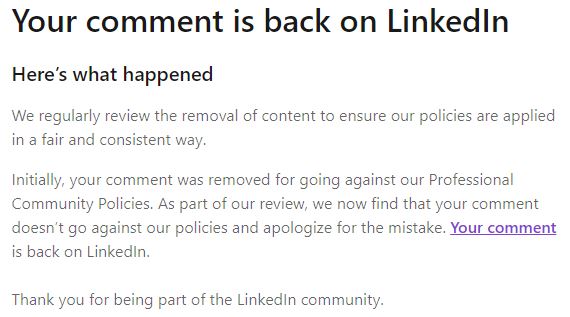
Post scriptum: I got a message from LinkedIn just now (only five hours after me stating my protest on perceived censorship) stating that my rather forceful comment on an post pleading for a ban on Russian tourism is back online. The link to the post did not work so I am not quite sure, but it is sufficient to restore my confidence in LinkedIn as one of the very few open social media in this rather bizarre world of social media and public discourse. I did learn my lesson, though: I will try to refrain from posting messages that go against the grain of sentiment. It is – quite simply – not very productive.

Post scriptum 2: One hour later, I got a message that LinkedIn re-reviewed their decision. I copy below. What the hell?

Reference # 220815-003288 Status: ClosedView your case(s) on our Help Center You may reply to this case for up to 14 days

Response (08/15/2022 13:16 CST)

“After taking a second look, we confirmed your content goes against our Professional Community Policies, https://www.linkedin.com/legal/professional-community-policies. We understand that this might not be the response you wanted, but we work to apply our policies in a fair and consistent way for all of our members. Thanks again for being part of the LinkedIn community.”

The new Cold War with Russia and China (and censorship on social media)

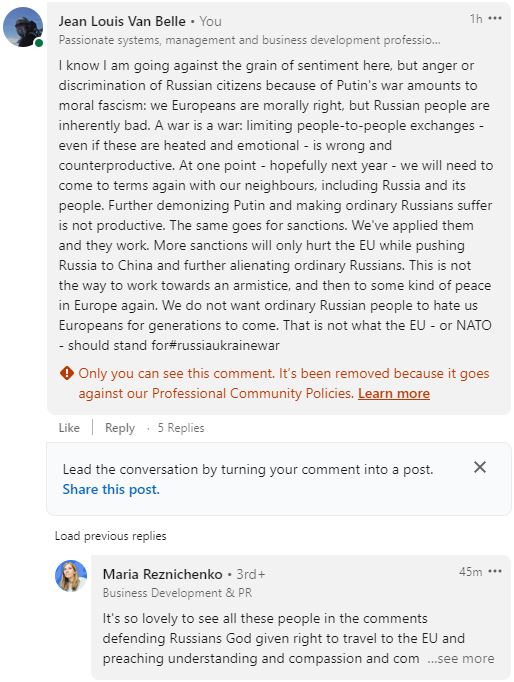
One man’s terrorist is another man’s freedom fighter. Russia and China engage in propaganda. The West, of course, does not. We only write about truth and peace and democracy. What nonsense! I reacted strongly – on my LinkedIn account – against what I perceive to be a new Cold War with Russia and China and – more to the point – how wrong it is to demonize not only leaders or systems but also people. Indeed, the Russian or Chinese people are not inherently bad and sanctions should, therefore, not be applied to people-to-people contacts, such as a ban on Russian tourism in Europe – which is currently being advocated by some European politicians (I am thinking of two new hawks here – both young, pretty and very woke, on the surface, at least).

My post was removed. See the screenshot below. It will not make me change my mind. On the contrary: I am someone who would rather defend or even exaggerate an unpopular view rather than adapt it to please the other side. It makes me feel that we live in dangerous times, and that free speech is under attack. Not only in the East but also in the West. This confirms what I wrote in previous posts. We are straight back where we were 50 years ago – right back to the old world order: a terribly Cold War. It is a Cold War with China, and a hot war with Russia too! I tell my children not to worry about it and just have fun but, deep inside, I feel very sad. It feels like this generation has failed on all fronts: climate change, peace, poverty, exclusion, etcetera. I hope the next generation will do better but, judging from what young and popular European politicians such as Kaja Kallas and Sanna Marin are pleading for, I have little hope.

They are supported very vocally by a majority of smart young business-minded people from former Eastern Europe as well as by very vocal Ukrainian migrants here. While I understand what they are saying, I would suggest they go back to their own country and make a difference there. We do not need more warmongering here in Europe.

As for social media censorship, some kind of regulation is obviously needed. We do not want senseless material to go viral. However, I feel the only way to keep it transparent is to do it like Twitter is doing it: they do not resort to trolling or patrolling threads and then randomly deleting tweets but just stick to clearly identify and labeling the source for what it is. For example: tweets by government officials (be they US, Chinese or Russian or whatever nationality) are clearly marked as such. Hence, exaggerated or weird claims are not being censored (removed) but their source is appropriately flagged. I like that. Facebook says it has policies in place that should filter things out but, whatever these policies are, they are not clear to me and I will, therefore, not use FB anymore for political comments.

I do not believe it is useful to try to actively filter out messages. Tracing and marking the source of a message should do. As far as I can see from my analysis while participating in Twitter discussion threads, Twitter is quite good at that. The interesting thing here is that both Russia and China have an official ban on Twitter but that the ban does not apply to government officials and that, in China and Russia itself, private users do circumvent the ban without too much trouble.

Elon Musk wrote that he was/is interested in acquiring Twitter because he wants to turn it into some kind of ‘absolutist free speech’ medium. Many people may think he cannot possibly be serious. Based on my (admittedly limited) experience with Twitter, I feel he has got a point. I like Twitter. As mentioned above, I feel that the regulation they have put in place is effective: clearly marking the nature of the source of a social media message is probably sufficient to make sure its readers read it with the “pinch of salt” that is required. I think the regulation of social media should be based on the Twitter model: one can write what he or she wants but you should identify yourself and what you stand for. The rest is for the reader to judge. We should not underestimate his or her intelligence and we should – surely – not judge in his or her stead.

You may not agree with my views above. That is fine. All that I am asking is that you question whatever would irk you and make you feel that I am totally wrong. If you come out of that exercise with a confirmation of your own views – even if they would be and remain diametrically opposed to mine – then that is fine. That is what rational discussion and finding a good middle ground through dialectical exchange is all about.

Post scriptum: You may think I should request a second look at the case from the LinkedIn editors. I did. I used their appeal procedure, and wrote this as justification for asking a review for the removal of my comments:

“I know my comment is a minority view but I wrote it because I feel it is true and because I feel I must go against the grain of sentiment here. I am one of few Europeans who have seen the horrors of war up close and who – unlike some of the people who may find it offensive – did not flee Ukraine but went to fight there. I came back. Alive and sane. Yesterday I was told some of my friends are dead or lost limbs. I think you should look at the Twitter model for weeding out comments. They label content as offensive or clearly mark the nature of the source. I wrote about that on my political blog just now: https://webeu.news/. I am fine with clear feedback: perhaps LinkedIn is not the fora for such discussions. However, I do not see why there should be no equal treatment of majority and minority views.”

I am curious to see if they will reply and, if so, what they will do or write. As for now, I will refrain from further posts or comments on political issues on that channel. It is not good for my business anyway, so I should not bother and do what is right for me. 🙂

The end of ideology and the (ir)relevance of NATO

Shortly after the Berlin Wall came down, the US-led alliance of nations that is known as the North Atlantic Treaty Organization (NATO) pushed the eastern borders of its territory all the way up to what are now the western borders of Russia, Belarus and Ukraine. [Instead of NATO, I could have referred to ‘the West’ as a whole, but it is better to be precise when writing about these things.] It is a rather moot point whether or not such expansion was tacitly agreed with the leaders of what was then a rapidly disintegrating Soviet Union. In 2014, former Soviet leader Mikhail Gorbachev said that NATO’s enlargement was, quite simply, “not discussed at all” at the time, so we should probably leave the historical discussion at that.

One thing is quite clear, however: no one in Europe thought Ukraine was part of Europe until Mr. Putin decided to invade it. That is the number one reason why NATO refused to get involved in it: the ‘in’ or ‘out’ of area distinction is just a legal nicety which NATO (the US, I should say) uses as it pleases. Indeed, NATO went to Afghanistan so there is no reason why they should not go to some other area if NATO member countries would agree on going there. Personally, I think it is a very wise decision for NATO members to leave NATO out of the war between Ukraine and Russia. Furthermore, from the historical record, it may not be very clear that NATO would be pushing east, but one thing that is very clear is that NATO would not turn against Russia. So what is it that I want to say here?

I just want to illustrate such things are a matter of choice and, at the same time, question the relevance of NATO: if NATO is not there to defend us against potential Russian aggression, then what is its use? The only reasonable answer is: NATO is there to do whatever the US wants its European partners to do with it, and they can decide to go along with it or not to go along with it. If Europe is serious about European defense integration, then we should cut the umbilical cord with the US.

Think of it. Shortly after the Berlin Wall came down, political philosophers (read: ideologues) like Fukuyama mourned or, more likely, celebrated the ‘end of ideology’. Fukuyama, for example, wrote this: humanity has reached “not just … the passing of a particular period of post-war history, but the end of history as such: That is, the end-point of mankind’s ideological evolution and the universalization of Western liberal democracy as the final form of human government.” Thirty years later, history proved him wrong: unlike the Soviet Union, China did not disintegrate. It successfully suppressed the Tiananmen protests and it restructured its economic and political system, in a very unique model which you may or, more probably, may not want to qualify as liberal. I think of this as follows:

1. From an economic point of view, it is probably more liberal than any other system (just care about money, business and wealth production).

2. From a political point of view, the system is not what many casual observers think it is: China’s one-party system clearly allows for different opinions being expressed internally and fierce competition from within the system. Otherwise China would not be where it is now. Also, I have had the pleasure to interact with Chinese diplomats in Asia (12 years of diplomacy, which ended in Afghanistan) and I found they suffered less from the typical ‘groupthink’ problem that marks some other diplomatic corpses.

In any case, what is obvious is that its system is, by far, more successful than the Anglo-Saxon (US or UK) or European system, as evidenced by the fact that China, over the past decades, grew to become the largest economy in the world. Indeed, China’s GDP is now commensurate with its population: measured in purchasing power parity terms, it is the largest in the world. Back in 1989, China’s GDP was only ninth in the rankings. So are we or are we not witnessing the end of ideology or – worse – the end of history, or not?

The answer is rather obvious to me: history never ends (it was so foolish to write something like that) and, therefore, our views on how to manage our societies will also continue to conflict. In that sense, we are surely not witnessing any end to ideology. If anything, that is what the recent clash around the US and China is all about. Truly wise political philosophers should just observe current international realities: the world has, de facto, become multipolar. It is one interconnected world indeed, but it is comprised of many cultures and very different political and economic systems. Such diversity is good.

So, yes, while we are not seeing the end of ideology, we should move beyond ideology and focus on peaceful coexistence and finally be very serious about working towards “the greatest good for the greatest number”, as Jeremy Bentham – the father of liberalism, utilitarianism and pragmatism – said we should aim at above anything else. That means, among other things, working with rather than against China. And it surely means refraining from any aggression or interference in the internal matters of other countries – especially those countries that, through sheer hard work, have seen their wealth growth to levels that are at par of the wealth of the West.

Also, when war is inevitable – as it was between Ukraine and Russia this year – then one should respond firmly (as Europe and the US did) but one should also prepare for armistice and peace as soon as possible. That is not happening now: shipping US$40b arms packages to Ukraine is not what is needed now. For those who are not familiar with such numbers: the annual defense budget of Russia is about US$65b and most of that is spent on salaries: not on highly lethal offensive equipment. So, yes, such interventions totally reversed the initial perception of a David versus Goliath relation between Russia and Ukraine: Ukraine is now, by far, the most powerful army in Europe, and it is not because of NATO or European support. It is because the US took over. That is a fact. Do we want that? Possibly. We just need to be aware of it.

The frontlines are all but frozen now, and the US and Europe need to work with China to end the war. Through hard-nosed diplomacy rather than more sabre-rattling. More sanctions do not only hurt ourselves but – more importantly – risk alienating Russia (not only its leaders but – much more importantly – their citizens) to a point of no return. That is not what we want: Russia is and remains our neighbor, and – just like individuals – countries need to learn how to live with their neighbors. :-/

Post scriptum: When you are a European or an American reading this, you may be irked and think that I think of the Chinese way of living as, somehow, being superior to ours. I do not. I lived in Asia for a long time (20+ years), and I also lived in the US (Washington DC) for a couple of years (I was married to an American woman). Now I live in Brussels. In the country where I was born and grew up: Flanders, Belgium, Europe (Europeans have multi-layered identities, don’t they?). I think of it as the best place in the world, but that is probably because, yes, I was born and grew up here. There is no place like home and, yes, ‘home’ is, of course, a very different place for all of us – just like family is different for all of us. That is good. That is how it should be. That is why the world is such fun place and why wars should be avoided at all costs: war destroys homes and families. I have witnessed that in Afghanistan and in Ukraine. I have seen enough of it.

Just for the record, I add a personal note on why I think I should speak up in regard to the need to seek peace with Russia. I left for Ukraine as soon as President Zelensky made his appeal to European and other international volunteers to join the fight. I would have stayed on (many left after the terrifying strike on the Yavoriv base, but I did not) but, sadly, when seeing lots of idiot volunteers and private companies and militias from the US swamping in about a month after we had arrived, I thought it was no longer worth it: we are all ready to die for the right cause but if, I use Sun Tzu’s words here, you no longer find yourself on the right side of the Moral Law, then it is better to go home. From a practical point of view, the Ukraine-Russia war is now a war between Russia on one side, and Ukraine and the US on the other. It is no longer the war between Russia and Europe that our media pretend it to be. Here too, I do not mince my words: Yankee, go home. Please. We Europeans can and will deal with Russia. They are our neighbor. We will find a way. How?

Well, for starters, the EU’s relationship with the country that now has the most leverage on Russia (yes, China) has remained relatively unaffected. Let us bank on that to begin with. I also think Europe’s diplomats do not have the kind of ‘with or against us’ attitude that is so harmful in such situations. Let me be blunt here: European diplomats do not display arrogance and are not complacent. That is why Chinese and Russian diplomats will probably find it easier to talk to them. If your only tool is a hammer, then every problem looks like a nail. So, if your only tool is a gun, then… Well… Then everyone looks like your enemy, right? Europeans do not think like that. Why? History: this continent remembers its wars and has learnt from them. Unlike the US, Europe did not go to war again after WW II (except for the Korean war, perhaps, as part of the United Nations). The US has fought many wars in foreign lands since then, and participated in even more proxy wars during the Cold War. These wars have been everything but successful, and I see little or no learning from them at all. :-/

The old new world order

The current Taiwan Street crisis is not the first tense moment in the history of China’s difficult relations with the US. However, previous crises were triggered by China: this is is the first time that such crisis was triggered by the US. That is a fact, and it is what leaves observers like me totally baffled. Why? Why now? Regardless of whether or not Ms. Pelosi’s visit was coordinated with Mr. Biden and the US foreign affairs and security establishment, it is a fact that it trashed all credibility of the United States as a predictable and reliable partner for peace and stability in Asia.

With a war against Russia in our backyard (I am a Belgian living and working in Brussels) and the US acting irresponsibly in Asia (barely recovering from its disastrous 21st century wars in Iraq and Afghanistan and plenty of lesser adventures in Africa and elsewhere in their self-declared war on terrorism), Europeans are left wondering what will be next. Optimist hawks point to the new relevance of NATO with the joining of previously neutral Sweden and Finland. I am not so optimistic. Two points may be made here:

1. Such NATO expansion confirms Russia’s worst existential fears: NATO is not about coexistence with Russia (or China) but about further expansion of a US-led block that refuses to accept the fact that the world has, de facto, become multipolar: one world, many cultures, different political systems. Unlike China, the West refuses to move beyond ideology and focus on peaceful coexistence and work towards “the greatest good for the greatest number.” I am quoting the English philosopher Jeremy Bentham here. I am doing so very consciously: when talking liberal ideologies or democratic values and all that, it is always useful to go back to the original liberal and utilitarian views that inspired our societies rather than refer to some kind of new variant of it (think of the American Dream or other modern rephrasing of the values of democracy and freedom).

2. Ukraine no longer needs NATO. NATO is irrelevant: it is mainly the US that is providing the sophisticated multi-billion dollar weapon systems that Ukraine has been asking for. The Ukrainian Army is now one of the most powerful armies in the world (much behind the US but probably at par with European countries such as Germany, France and the UK). That is not because of European support, which is counted not in billions but in millions. That is also not because of NATO support (there is none). It is because the US decided to just take over. After its pull-out from Afghanistan, it is rather convenient to have the old enemy back again: Russia.

And now China is back as the number one enemy well. Good old bad China. And good old bad Russia. The war on terror became a bit difficult to defend domestically anyway. So we are back to the future. Or back to the past: a new Cold War with supposedly communist and dictatorial regimes that supposedly threaten our lifestyle, culture and freedom.

There are a few differences, however. Back in 1989, when the Tiananmen protests were suppressed and led to a profound restructuring of China’s economic and political system, China’s population was the largest in the world (as it is now, even if India, which did not manage to make the demographic transition, will soon have even more people to feed than China), but its gross domestic product (GDP) was only the world’s ninth largest. China’s GDP is now commensurate with its population: measured in purchasing power parity terms, it is now the largest economy in the world.  

A somewhat more relevant difference is that trust in the US acting as a benevolent protector of world peace and stability has been eroded. I do not have any statistics on this but I would not be surprised if confidence levels would now resemble those of Americans themselves: a 2021 Reuters-Oxford study shows less than 30% of US citizens trust what they are being told by their own media outlets. I quote: “The United States ranks last in media trust — at 29% — among 92,000 news consumers surveyed in 46 countries, a report released [last year] found. That’s worse than Poland, worse than the Philippines, worse than Peru. Finland leads at 65%.” Now that I look at it again, I see that the 2022 report is out. There is no improvement: “Only 26% of Americans trust news generally.” That is a 3-point decrease and still the lowest figure in the sample. If US citizens do not trust their own government and/or media, why would we?

I am not a China expert but, from what I read and know about the political system in China (and from discussions with Chinese friends here in Brussels), I have more trust in China’s one-party democracy than in the two-party cut-throat system in the US. Just for the record and to be clear on where I stand here: I do not have such trust in Russia’s political system: President Putin must end the war and Russia’s political system will have to change and evolve with the times. I am not talking regime change here: I am just talking plain sensible domestic reforms, just like what China does. Putin has got what he wanted: a large land corridor to the Black Sea which, yes, is vital to Russia’s interests (historically speaking, the Crimea is Russian). So, yes, now it is time for Mr. Putin to back off and for both sides to cut a painful but acceptable deal ending the killing and suffering.

I had hoped Mr. Biden and Mr. Jinpeng would have worked together to jointly convince Mr. Putin of such point of view, broker some armistice and freeze the conflict so as to stabilize Russia’s economy and stop hurting citizens on either side, but Ms. Pelosi’s unannounced and totally random visit to Taipei dashed all hopes in that regard. One can only conclude that Uncle Sam loves and hates the good old bad Russians so much that he is happy to be at war with them again. So where are we headed, then?

1. As mentioned above, as a European, you may think that NATO is relevant again and that our governments doubling defense spending will make things better but that is a mirage (meaning: an optical illusion). NATO is irrelevant. Us buying more guns or having more nuclear-tipped missiles on our soil makes zero difference in terms of posture or possible deterrence of any security threat that may or may not be out there.

2. The largest threats to world peace and security now are, without doubt, flashpoints in Asia. Such threats range from Iran over Pakistan and India (tensions between those two countries can also not be analyzed without taking China into account) all the way to the Pacific Ocean with, yes, the Taiwan Strait and North Korea as the most ‘clear and present danger’ to peace and stability in Asia.

I am not worried about these threats. To be blunt: they are none of our business. They may have been our business 30 years ago, back in the old days of this Cold War between East and West. Today, we are well into the 21st century and that is a entirely new era in which we should just tag along with whatever happens around us. To be extremely blunt and very clear on where I stand on this: there is absolutely no reason whatsoever why we Europeans would want to be dragged into the next war which, as outlined above, is likely to be in Asia. For example, why would we or our sons want to get killed in the defense of, say, Taiwan against a Chinese invasion? We only need Taiwan’s microchips, right? Why would we care if those are produced in China or in Taiwan or in some kind of new Greater China? Also, South Korea is well equipped to deal with a conventional challenge from the North. No reason for us to get involved.

Having said that, wars always have a tendency of spiralling out of control and that is why we should be worried. We can, therefore, only hope that China will effectively maintain the status quo and continue its long-held goals of peaceful coexistence – as it did when Hong Kong ceased to be a British colony and went back to the mainland as per the terms of the 1898 lease agreement between what was then Qing China and the United Kingdom (one country, two systems).

So what role is there for Europe and the US then? There is none. In my previous post, I wrote this: “It is about time that China, Korea and Japan find the peace they never had – still mourning the injustices of the second world war – a war that was not theirs to choose. This Taiwan crisis makes it clear that the US has outplayed its role in the East. The Europeans remain powerless in the middle (but Europe has plenty of brains and true multiculturality to offer). Peace in Asia will be peace for the world – and the only nations that can bring it to Asia are Asian countries.”

Two friends of mine (one Korean, one Belgian) told me such view is naive. So be it. I tell my kids not to worry about war in Africa or Asia. In contrast, war in Europe – as we have now – is an obvious worry, but dropping more and more multi-billion arms packages in there and refusing to talk to Russia (and China) – as the US Secretary of State did when he had a golden chance to talk to his Russian and Chinese counterparts but did not grasp it two days ago (at the occasion of the East Asia Summit) – is not a great way of starting to deal with it.

[I am polite and phrasing this very euphemistically. Think about it honestly: who was/is not talking to whom here? Also, if Ms. Pelosi would be serious about peace and democracy in Asia and, perhaps, want to talk about things she does not like about China, then why did she not want to see Xi Jinpeng himself and/or his much beloved (in China, that is) wife Peng Liyuan while flying around in the region there? Knowing a thing or two about protocol and hospitality in Asia, I am sure she would have been well received. Anyone who knows Asia, knows how important it is to respect protocol and, surely, how to avoid a loss of face, which is exactly what she caused: a loss of face for China. This is not going to be fixed or pardoned any time soon. Diplomacy is wasted now.]

In short, yes, it is back to the future, with one big difference: we should not trust the US to defend our interests anymore. We should do that ourselves. And we can do that by staying clear from irking large and powerful nations such as China and Russia: let them run their country the way they see fit. Let us accept to live in this multipolar but largely peaceful world and accept diversity: many cultures, different systems of governance, and all the richness that comes with it. We do not need a global cop. Especially not a global cop that keeps repeating the same line over and over again: “You are either with us or against us.” It may be a military principle (not part of Sun Tzu’s rather successful Art of War principles, however), but politics – national or international – simply do not work that way. We can self-regulate based on well-established international rules: territorial integrity, non-interference in domestic affairs, no extrajudicial killings in foreign lands, etcetera. Global cowboys have no place in such system. If the US would want to be constructive, it could, possibly, lead the way if it wants to by, for example, bringing its own defense budget closer to the NATO average rather than us ramping it up.

[…] Hey ! I like that idea ! That is a nice compromise to offer to the US telling us to arm up, isn’t it? We go up if you come down ! I really like that idea. It would make us feel safer. It would also make NATO look more like a true alliance. Consider this: when the US went to fight the Taliban in Afghanistan, they just dragged all NATO countries with them. It was qualified and justified as an ‘out of area’ NATO operation with, of course, most of the command and control done by the US. The NATO Council members were bullied into it and justified it legally to the taxpayers and other audiences by a reference to the war on terrorism which, as far as I know, has no real legal basis from an international law point of view. But that was it. I was there too for my own country (Belgium) and it was all very interesting. But so now we have a real war much closer to Brussels or Berlin or Paris and London but NATO shits in its pants and leaves the war to international volunteers and, yes, the US.

I went to Ukraine too, by the way. Unofficially, this time around. And only very briefly, back in March. As a volunteer fighter. Yes. Watch this newsreel if you do not believe me: I am featured in it, shortly after we went underground after a Russian missile strike on our training basis. I could see all those guns coming in after a month or so, plus a lot of other people who were either more naive or – the opposite – much more useful than me, and so I decided to come back home. Not because I got scared (I stayed much longer than others) but because I was not needed: there were enough guns coming in and, yes, more than enough other volunteers who, unlike me (I was just a diplomat in Afghanistan doing civ-mil cooperation as Belgium’s chargé d’affaires), had real combat experience and better reasons to not like the Russians. I think of the many Georgians joining the Legion, for example. And, yes, many crazy Americans with no knowledge of the law of war and no respect whatsoever for the enemy (they found it strange, for example, when I would remind them of the fact that Russian soldiers were also fathers or sons and were not at the front because they wanted to be at the front – unlike them trigger-happy American volunteers). :-/

OK. Let me get back to the point instead of talking personal stories. The point is this: if the Russian invasion of Ukraine is a clear and present danger but NATO does not want to get involved because it got cold feet after the failure of the Afghanistan operation (what were we doing there, anyway?), then what is the use of NATO? It is a bit hard to not conclude that it currently just serves as some kind of collective market for buying US defense equipment, right? That is another reason why I am against a rise in defense spending:

1. It does not make us safer (see above).

2. I do not think European taxpayer money should be used to enrich the shareholders of US defense companies and further strengthen what the great American general Eisenhower and then US President warned his own countrymen for back in 1961: the growing military-industrial complex and its influence on politics.

It is now clear that Eisenhower’s nightmare has become true: the US military-industrial complex is now a fully-fledged military-industrial-political complex. Democrats or Republicans make no difference any more, as evidenced from the GOP praise for Ms. Pelosi’s brinkmanship. All leading US politicians are anti-China and, therefore, there is little hope either of the two parties will contribute much to peace and stability in Asia. If, as is very likely judging from the polls, we will see a lame duck government in the US after the November elections (when Republicans are likely to take over US Congress), Republicans and Democrats are likely to agree on the following: keep increasing the already enormous US Defense budget, keep pestering China, keep the war in Ukraine going and, possibly, send troops to other flashpoints (there is plenty of choice in Africa, and no one really cares about that continent anyway – except for China, perhaps).

Does this sound arrogant? Probably. Most probably. Plain arrogant. You are right. However, having survived a suicide attack, multiple RPG barrages, cross-fire, and other hazards in Afghanistan as well as, more recently, a missile strike in Ukraine as part of the volunteer International Legion in Ukraine (that strike made hundreds of casualties but I was lucky, again), I think I have the right to speak up and repeat the core message of my previous post: Yankee, please go home. You are not helpful when it comes to avoiding, preventing, or mitigating conflicts, and you are surely not very helpful when it comes to trying to broker compromise and end conflict.

Yes, your army is more powerful than all other armies combined and does easily ‘win’ wars in true Blitzkrieg style (‘shock and awe’ tactics as you call it). However, you have demonstrated that you never ever win the peace that should necessarily follow. The Cold War was followed by a very cold peace, and now you have turned back into another Cold War. Worse, proxy wars have given way to a real war with Russia. Its start was Russia’s mistake, for sure. But the multi-billion dollar equipment packages and the trainers that come with it do not help in bringing it to an end. That requires hard-nosed diplomacy, and the Pelosi visit shows you do not want to use that. So please stay away then and stop fueling fires. Surely avoid starting new fires. It is simply too hot right now. Also, one of the many Afghan sayings I learned from my 12 years there (7 years permanently and 5 years on and off) is this: jangal ke dar gereft, khushk o tar mesoza. Literally translated it means this: “If a forest catches fire, both the dry and the wet will burn up.” We Europeans really do not want any forest to burn. Forest fires are hard to control. :-/